Christianity · c. 220 CE
On First Principles (De Principiis)
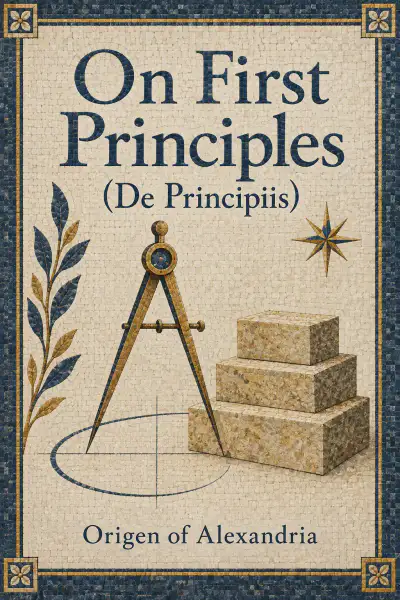
The first attempt at a complete Christian theology: God, Christ and the Spirit, rational beings and their fall, free will, the end of all things, and how to read Scripture.
Translated by Frederick Crombie (1869)

Reading this book
Begin with Book I, chapter I. Book III on free will and Book IV on Scripture are the most influential parts and can be read on their own.
Where to start
- On GodGod as incorporeal mind, beyond any body or place.
- On falling awayHow rational beings fell from God by their own will.
- On the endOrigen’s hope that all things will be restored.
- On free willBook III, chapter I: the long defence of human freedom.
- How to read ScriptureBook IV: the body, soul and spirit of the biblical text.
About this book
Origen of Alexandria (c. 185 to 253 CE) wrote On First Principles (Peri Archon) around 220 to 230 CE. It sets out what the church teaches, then reasons about questions the teaching leaves open: the pre-existence of souls, whether demons can be saved, and whether all things will finally be restored to God.
Some of these ideas were condemned centuries after his death. The Greek original is mostly lost; the full text survives in Rufinus’s Latin translation of 398, which softened passages Rufinus thought unorthodox, alongside Greek fragments.
This translation
Frederick Crombie translated the work in 1869 for the Ante-Nicene Christian Library. He translates Rufinus’s Latin and sets the surviving Greek and Jerome’s reports beside it where they differ.
In the app
- 224 commentary notes
- Ask the Guide about what you’re reading
Membership includes narration, illustrated Readings, lessons, the Guide and full commentary. Individual lessons can also be bought to keep. Every book is free to read.
Read in the appContents
25 chapters25 chapters · Page 1 of 1
- 1Book I, Chapter I: On God
- 2Book I, Chapter II: On Christ
- 3Book I, Chapter III: On the Holy Spirit
- 4Book I, Chapter IV: On Defection, or Falling Away
- 5Book I, Chapter VI: On the End or Consummation
- 6Book I, Chapter VII: On Incorporeal and Corporeal Beings
- 7Book I, Chapter VIII: On the Angels
- 8Book II, Chapter I: On the World
- 9Book II, Chapter II: On the Perpetuity of Bodily Nature
- 10Book II, Chapter III: On the Beginning of the World, and Its Causes
- 11Book II, Chapter IV: The God of the Law and the Prophets, and the Father of Our Lord Jesus Christ, is the Same God
- 12Book II, Chapter V: On Justice and Goodness
- 13Book II, Chapter VI: On the Incarnation of Christ
- 14Book II, Chapter VII: On the Holy Spirit
- 15Book II, Chapter VIII: On the Soul (anima)
- 16Book II, Chapter IX: On the World and the Movements of Rational Creatures, Whether Good or Bad; and on the Causes of Them
- 17Book II, Chapter X: On the Resurrection, and the Judgment, the Fire of Hell, and Punishments
- 18Book II, Chapter XI: On Counter-promises
- 19Book III, Chapter I
- 20Book III, Chapter I: On the Freedom of the Will, with an Explanation and Interpretation of Those Statements of Scripture Which Appear to Nullify It
- 21Book III, Chapter II: On the Opposing Powers
- 22Book III, Chapter IV: On Human Temptations
- 23Book III, Chapter VI: On the End of the World
- 24Book IV, Chapter I: That the Scriptures Are Divinely Inspired
- 25Book IV, Chapter I: On the Inspiration of Holy Scripture, and how the Same is to be Read and Understood, and What is the Reason of the Uncertainty in It and of the Impossibility or Irrationality of Certain Things in It,…