Classical · c. 300 CE
Iamblichus' Life of Pythagoras
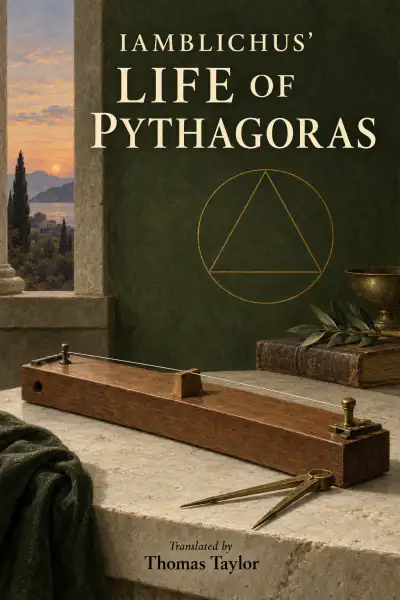
A Neoplatonist’s portrait of Pythagoras as philosopher, teacher and holy man: his travels, his community at Croton, the five-year silence, music as medicine, and the rules of Pythagorean life.
Translated by Thomas Taylor (1818)

Reading this book
The chapters are short and have no titles. Use the list below to find the famous episodes; the fragments and sayings at the end can be read on their own.
Where to start
- The first philosopherWhy Pythagoras called himself a lover of wisdom, not a wise man.
- Testing new studentsExaminations and the five years of silence before full admission.
- Teaching by symbolsThe Pythagorean sayings and how they were meant.
- The discovery of harmonyPythagoras hears the blacksmiths’ hammers and finds musical ratios.
- On friendshipPythagorean friendship and its famous examples.
- Sentences of SextusShort sayings on God, the soul and self-control.
About this book
Iamblichus (c. 245 to 325 CE) was a Syrian Neoplatonist philosopher. He wrote this life of Pythagoras, who lived some eight centuries earlier, as the opening of a larger work on Pythagorean philosophy, gathering earlier biographies and traditions.
His Pythagoras is half philosopher and half saint. Iamblichus is not a critical historian, but he preserves much of what later antiquity believed about the Pythagorean community: its tests for students, its diet, its use of music and symbols, its friendships and its persecution.
This translation
Thomas Taylor, the English Platonist, translated the Life in 1818. His English follows the Greek closely and can be stiff. This edition adds fragments of early Pythagorean writers and collections of Pythagorean sayings that Taylor translated.
In the app
- 37 commentary notes
- Ask the Guide about what you’re reading
Membership includes narration, illustrated Readings, lessons, the Guide and full commentary. Individual lessons can also be bought to keep. Every book is free to read.
Read in the appContents
54 chapters54 chapters · Page 1 of 1
- 1Chapter I
- 2Chapter II
- 3Chapter III
- 4Chapter IV
- 5Chapter V
- 6Chapter VI
- 7Chapter VII
- 8Chapter VIII
- 9Chapter IX
- 10Chapter X
- 11Chapter XI
- 12Chapter XII
- 13Chapter XIII
- 14Chapter XIV
- 15Chapter XV
- 16Chapter XVI
- 17Chapter XVII
- 18Chapter XVIII
- 19Chapter XIX
- 20Chapter XX
- 21Chapter XXI
- 22Chapter XXII
- 23Chapter XXIII
- 24Chapter XXIV
- 25Chapter XXV
- 26Chapter XXVI
- 27Chapter XXVII
- 28Chapter XXVIII
- 29Chapter XXIX
- 30Chapter XXX
- 31Chapter XXXI
- 32Chapter XXXII
- 33Chapter XXXIII
- 34Chapter XXXIV
- 35Chapter XXXV
- 36Chapter XXXVI
- 37Fragments: From Hippodamus, on Felicity
- 38Fragments: From Euryphamus, on Human Life
- 39Fragments: From Hipparchus, on Tranquillity
- 40Fragments: From Archytas, on the Good and Happy Man
- 41Fragments: From Theages, on the Virtues
- 42Fragments: From Metopus, on Virtue
- 43Fragments: From Clinias
- 44Fragments: From Theages, on the Virtues (II)
- 45Fragments: From Archytas, on Ethical Erudition
- 46Fragments: From Archytas, on the Good and Happy Man (II)
- 47Fragments: From Crito, on Prudence and Prosperity
- 48Fragments: From Archytas, on the Good and Happy Man (III)
- 49Fragments: From Archytas, on Disciplines
- 50Fragments: From Polus, on Justice
- 51Pythagoric Ethical Sentences from Stobæus
- 52Select Sentences of Sextus the Pythagorean
- 53Pythagoric Sentences from the Protreptics of Iamblichus
- 54Additional Notes