Classical · c. 340 BCE
Nicomachean Ethics
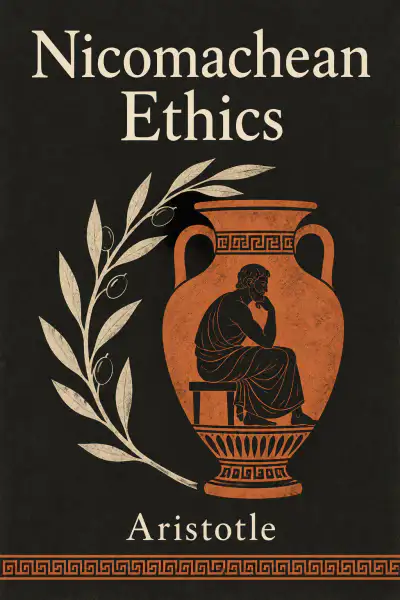
Aristotle’s lectures on how to live well: what happiness is, how good character is formed by practice, why virtue lies between extremes, and what friends are for.
Translated by W.D. Ross (1908)

Reading this book
Book I sets out the question and the rest builds on it. If you want the core quickly, read the chapters marked below, then return for the books on justice, practical wisdom and self-control.
Where to start
- Every art aims at some goodThe famous opening and the question of the chief good.
- The function of manBook I, chapter 7: happiness as activity of the soul in accordance with virtue.
- Virtue comes from habitBook II: we become just by doing just acts.
- The meanBook II, chapter 6: virtue as a mean between excess and deficiency.
- FriendshipBook VIII: friendships of use, of pleasure and of goodness.
- The contemplative lifeBook X, chapter 7: why contemplation is the most complete happiness.
About this book
Aristotle (384 to 322 BCE) taught at the Lyceum in Athens, and this work is probably a set of his lecture notes, edited later and perhaps named for his son Nicomachus. It is in ten books.
Its central claim is that the highest human good is eudaimonia, usually translated as happiness or flourishing: an active life lived in accordance with virtue. Virtues of character are formed by habit, the way a builder learns by building. Two whole books on friendship and a closing defence of the contemplative life follow.
This translation
This is W. D. Ross’s translation, first published by Oxford in 1908 and for decades the standard English text. It is close to the Greek and fairly plain. Some key words differ from modern versions: Ross uses “happiness” for eudaimonia and “practical wisdom” for phronesis.
In the app
- About 8 hr 54 min of narration
- 2 illustrated Readings from this book
- 6 lessons cite this book, including Compassion
- 222 commentary notes
- Ask the Guide about what you’re reading
Membership includes narration, illustrated Readings, lessons, the Guide and full commentary. Individual lessons can also be bought to keep. Every book is free to read.
Read in the appContents
116 chapters116 chapters · Page 1 of 2
- 1Book I: The Good for Man
- 2Book I: Chapter 2.
- 3Book I: Chapter 3.
- 4Book I: Chapter 4.
- 5Book I: Chapter 5.
- 6Book I: Chapter 6.
- 7Book I: Chapter 7.
- 8Book I: Chapter 8.
- 9Book I: Chapter 9.
- 10Book I: Chapter 10.
- 11Book I: Chapter 11.
- 12Book I: Chapter 12.
- 13Book I: Chapter 13.
- 14Book II: Moral Virtue
- 15Book II: Chapter 2.
- 16Book II: Chapter 3.
- 17Book II: Chapter 4.
- 18Book II: Chapter 5.
- 19Book II: Chapter 6.
- 20Book II: Chapter 7.
- 21Book II: Chapter 8.
- 22Book II: Chapter 9.
- 23Book III: Moral Virtue
- 24Book III: Chapter 2.
- 25Book III: Chapter 3.
- 26Book III: Chapter 4.
- 27Book III: Chapter 5.
- 28Book III: Chapter 6.
- 29Book III: Chapter 7.
- 30Book III: Chapter 8.
- 31Book III: Chapter 9.
- 32Book III: Chapter 10.
- 33Book III: Chapter 11.
- 34Book III: Chapter 12.
- 35Book IV: Moral Virtue
- 36Book IV: Chapter 2.
- 37Book IV: Chapter 3.
- 38Book IV: Chapter 4.
- 39Book IV: Chapter 5.
- 40Book IV: Chapter 6.
- 41Book IV: Chapter 7.
- 42Book IV: Chapter 8.
- 43Book IV: Chapter 9.
- 44Book V: Moral Virtue
- 45Book V: Chapter 2.
- 46Book V: Chapter 3.
- 47Book V: Chapter 4.
- 48Book V: Chapter 5.
- 49Book V: Chapter 6.
- 50Book V: Chapter 7.
- 51Book V: Chapter 8.
- 52Book V: Chapter 9.
- 53Book V: Chapter 10.
- 54Book V: Chapter 11.
- 55Book VI: Intellectual Virtue
- 56Book VI: Chapter 2.
- 57Book VI: Chapter 3.
- 58Book VI: Chapter 4.
- 59Book VI: Chapter 5.
- 60Book VI: Chapter 6.