The library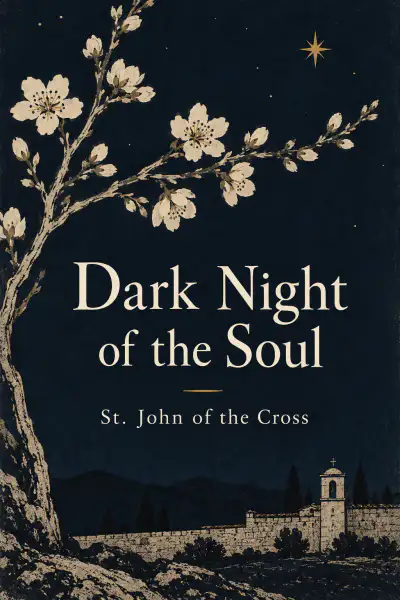
Christianity · c. 1585 CE
Dark Night of the Soul
St. John of the Cross's classic account of the soul's passive purgation in contemplative prayer — the 'dark night' by which God leads the mystic from the purgative to the unitive way.
Translated by David Lewis (1908, rev. Zimmermann)
39 chaptersAbout 3 hr 7 minFree to read, no account

In the app
- 43 illustrated Readings from this book
- 3 lessons cite this book, including Faith
- 118 commentary notes
- Ask the Guide about what you’re reading
Membership includes narration, illustrated Readings, lessons, the Guide and full commentary. Individual lessons can also be bought to keep. Every book is free to read.
Read in the appContents
39 chapters39 chapters · Page 1 of 1
- 1Book I, Chapter 1: Begins with the first stanza and treats of the imperfections of beginners
- 2Book I, Chapter 2: Of spiritual imperfections to which beginners are liable in the matter of pride
- 3Book I, Chapter 3: Of the imperfections to which beginners are liable in the matter of spiritual avarice
- 4Book I, Chapter 4: Of other imperfections to which beginners are liable in the matter of spiritual luxury
- 5Book I, Chapter 5: Of the imperfections of beginners in the matter of spiritual anger
- 6Book I, Chapter 6: Of the imperfections in the matter of spiritual gluttony
- 7Book I, Chapter 7: Of the imperfections in the matter of spiritual envy and sloth
- 8Book I, Chapter 8: Explanation of the first line of the first stanza — the beginning of the dark night
- 9Book I, Chapter 9: Of the signs by which it may be known that the spiritual man is walking in the way of this night
- 10Book I, Chapter 10: How the soul is to conduct itself in the night of sense
- 11Book I, Chapter 11: The second line of the first stanza explained — "With anxious love inflamed"
- 12Book I, Chapter 12: Of the benefits which the night of sense brings to the soul
- 13Book I, Chapter 13: Of other benefits which the night of sense brings to the soul
- 14Book I, Chapter 14: The last line of the first stanza explained
- 15Book II, Chapter 1: The second night — that of the spirit; when it begins
- 16Book II, Chapter 2: Of certain imperfections of proficients
- 17Book II, Chapter 3: Notes on that which is to follow
- 18Book II, Chapter 4: Explanation of the first stanza
- 19Book II, Chapter 5: Explains how this dim contemplation is not only night but also pain and torment for the soul
- 20Book II, Chapter 6: Of other sufferings of the soul in this night
- 21Book II, Chapter 7: The same subject continued — other afflictions and trials of the will
- 22Book II, Chapter 8: Of other sufferings which distress the soul in this state
- 23Book II, Chapter 9: How this night enlightens the mind though it brings darkness over it
- 24Book II, Chapter 10: Explanation of this purgation by a comparison
- 25Book II, Chapter 11: Begins the explanation of the second line — how a vehement passion of divine love is the effect of this dark night
- 26Book II, Chapter 12: Shows how this awful night is a purgatory, and how the divine wisdom illuminates men on earth
- 27Book II, Chapter 13: Other sweet effects wrought in the soul in the dark night of contemplation
- 28Book II, Chapter 14: Repeats and explains the last three lines of the first stanza
- 29Book II, Chapter 15: The second stanza and its explanation
- 30Book II, Chapter 16: Showeth how the soul journeys securely when in darkness
- 31Book II, Chapter 17: Gives the second line and explains how this dim contemplation is secret
- 32Book II, Chapter 18: Shows how this secret wisdom is also a ladder
- 33Book II, Chapter 19: Begins the explanation of the ten degrees of the mystic ladder according to St. Bernard and St. Thomas
- 34Book II, Chapter 20: Of the other five degrees of the mystic ladder of love
- 35Book II, Chapter 21: The meaning of 'disguised' — the colours in which the soul disguises itself in this night
- 36Book II, Chapter 22: Explains the third line of the second stanza
- 37Book II, Chapter 23: Explains the fourth line — the wonderful hiding place of the soul in this night, which the devil cannot enter
- 38Book II, Chapter 24: Concludes the explanation of the second stanza
- 39Book II, Chapter 25: In which the third stanza is briefly explained